Welcome to the Ant Encyclopedia!
For definitions of specific terms, please visit our glossary
Ants are AMAZING! In my opinion, they are some of the coolest insects ever to exist. The way they communicate, their social roles, their unique adaptations, and how structured their colonies are as a whole are very interesting. In this section of the introduction, you will be introduced to the world of ants.
Ant Anatomy
What are ants? This may seem like a stupid question, and a total piece of rubbish, but this is actually a really important question. Here is one of the pictures I have stumbled over when I first learned about ants:
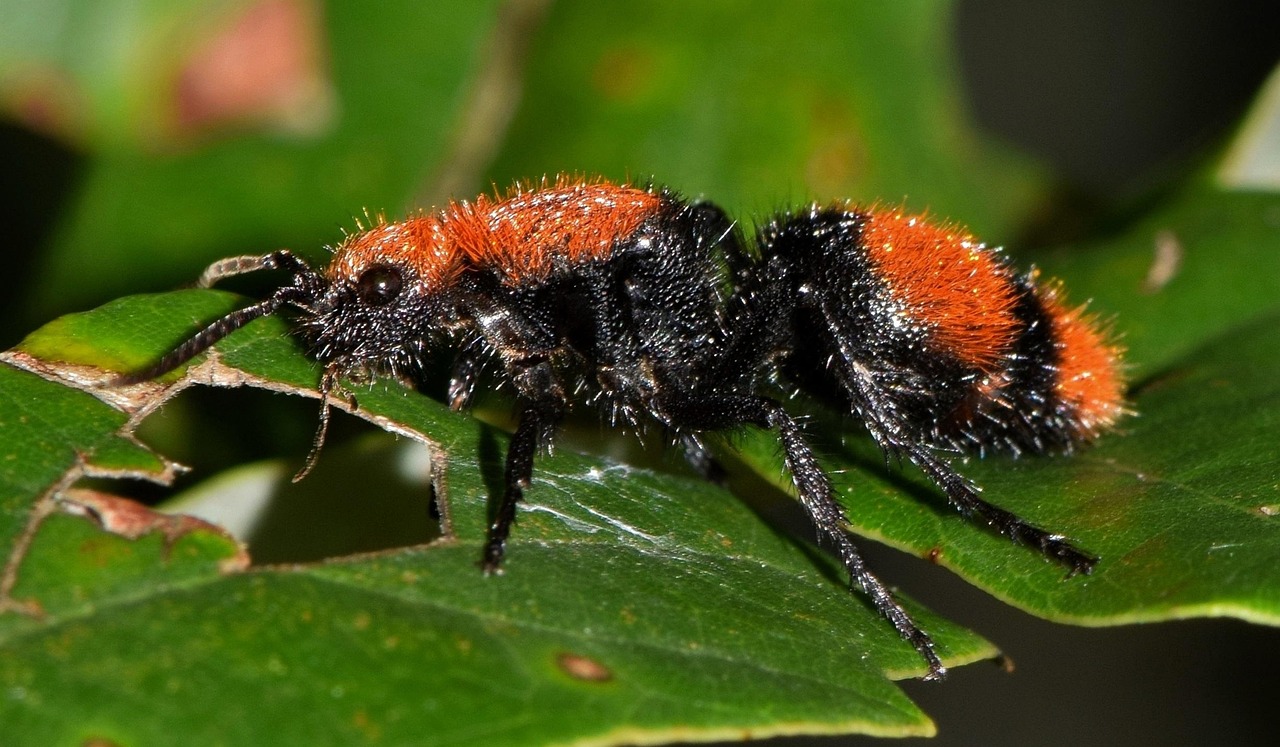
It might look like an ant at first glance (well, I thought so). I thought it has six legs, has two antennae, and it doesn't have wings. "What a cool ant!" I thought to myself. But then as I learned more and more about this insect, I discovered it's called a "Cow Killer", which is a type of wingless wasp! Wow!
An ant has all the features that every other bug has. They have two antennae, six legs, and a body divided into three parts: the head, thorax, and abdomen.
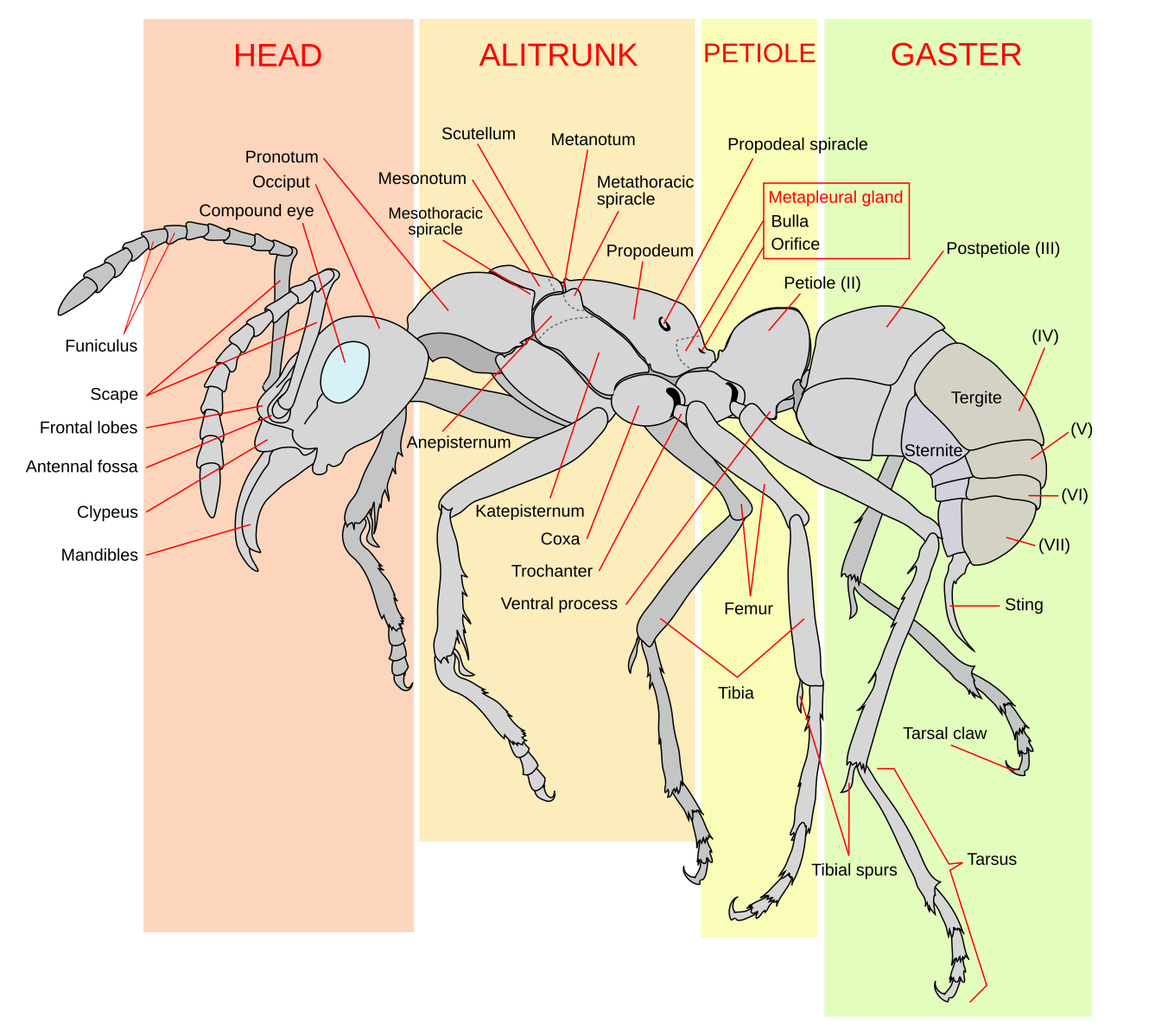
This may look very confusing, but to understand this website, you don't need to know every part of the ant. All you really need to know is:
- The head
- The thorax "alitrunk"
- The abdomen "gaster"
- The mandibles (located at the head)
- The antennae (located at the head)
- The legs (extends from the thorax)
- The exoskeleton (the hard shell that covers all insects)
- The compound eyes (located at the head)
- The stinger/acidopore (located at the abdomen, where it says "stinger"
- Their social stomach (not shown)
First of all, the mandibles are the teeth of the ant. The ant may use these teeth to pick up things or to slice things like food and other ants into smaller, more edible parts (or, in some cases, more dead parts). There is a big difference between the mandible and the mouth. The mandible is the teeth, used for picking thing up, but it alone can't eat anything. Instead, the mouth can drink and eat.
Secondly, we need to talk about the antennae. This is an extremely important sensory organ, and it is part of the secret of why ants, arguably, have also dominated the Earth. Their antennaes are very important for their communication. See, ants communicate with chemicals. One way they communicate is by laying down chemical trails from their abdomens to where there is a food source, a fight, or anything ants would want to go to in general. They sniff out these trails with their antennae. Another way they communicate with antennae are by touching other ants with it to communicate. For example, a certain set of antennae touching could convey that they want food.
The legs attached to the thorax are quite intuitive. They could also walk on vertical surfaces.
The exoskeleton is very interesting. It protects the ant's soft tissues and organs from outside harm, while also letting the ant breathe. The exoskeleton is basically a hard shell covering most parts of the ant.
The compound eye is a very interesting type of eye. Or should I say, eyes. The compound eye is made of thousands of mini eyes, collectively forming one image. This is why sometimes, an insect can see more than 18o degrees! This is at a cost, because then, their view of the world isn't as sharp as ours. Some ants are even blind!
The stinger/acidopore is a feature only select ants have. Some ants, like the famous Fire Ant (Solenopsis invicta), has a stinger on its abdomen. A stinger is used to puncture the surface of the thing it wants to sting, and the ant injects the venom in. Certain ants, like the Bullet Ant (Paraponera clavata) has an extremely painful sting, and they are some of the only ants that could land you in the hospital. An acidopore, on the other hand, doesn't sting. Instead an acidopore is for squeezing formic acid. The formic acid stench would fill the air, as ants squirt, like a water-gun, formic acid all over wherever they had been fighting. A not-so-famous example is that of the Weaver Ant (Oecophylla smaragdina). When other Weaver Ants attack, they squirt the acid to where the enemy is.
Finally, we arrive at the social stomach, which is hidden in the picture, but is actually inside the ant. The social stomach is different from it's normal stomach. The social stomach stores food for other colony members, and is very useful to ants.
So that concludes what you need to know about the anatomy of the ant. Let's move on to the reproductive cycle of an ant.
Reproductive Cycle of Ants
Ants have a very interesting reproductive cycle. Here is their full reproductive cycle of a monogynous queen:
- Egg (Eggs are tiny and will eventually hatch)
- Larvae (Larvae are larger ants that could eat, but cannot excrete waste, causing them to have dark spots inside their bodies)
- Pupae (Pupae is when larvae are metamorphosising into adult ants. Some species of ants spin cocoons when at this stage of development, while others have naked pupae. Naked pupae look like little white ants that have been folded in.)
- Adult (This is what we call the "generic ant". However, when they have just emerged from their pupal stage, they might look white or pale. This is the result of their exoskeleton no quite hardening yet, and this means their bodies could be squished easily. After some time, the exoskeleton will harden. All adult "normal" ants are female.)
- Queen/Drone (some ants are special, and become Queens or Drones. Queens are female ants that will take part in a nuptial flight at one time or another, and mate with drones, who are male ants)
- Repeat (after the nuptial flight, mated Queens will lay eggs in underground chambers, called the claustral chamber, unless the ant species is semi-claustral)
Nest Structures & Worker Castes
Most ants make nests underground, with tunnels and chambers runnning throughout. Workers also have many different roles to play in a nest. This part about the introduction will talk about the ant nest and how it functions.
Nest Structure
Ant nests are engineering marvels, and in this section, we are going to learn about the generic ant nest of ground-dwelling species.
Each nest has a central chamber where the queen lays eggs. The central chamber could also be called a royal chamber. The central chamber can be called a claustral chamber if the queen is a claustral species and workers have not started to make new chambers or dig out the nest yet.
There are also tunnels that connect chambers together and form passageways. It's how they move efficiently around the nest.
There are chambers located around the nest. Some big, some smaller, some house brood, some house food, chambers are created for a variety of reasons, though they are mostly used for containing something.
Some ant nests build mounds that are crucial to their survival. They build these mounds at their entrances, often with a few holes at the surface of the mounds, which are the entrances and exits.
Worker Castes
There are worker ants in all established colonies, and they are important to the survival of the queen, other ants, their brood, and basically their whole colony.
Worker ants have a variety of roles when serving the colony, and we are going to talk about how each of the castes all fill in these roles.
Workers, together as a group, must: Gather food, defend against enemies, care for the brood and the queen, and help with nest expansion.
In most nests, there are two worker castes: the Minors, and the Majors (different species tend to have different set of worker castes, but most have these two)
Minors
Minors are smaller ants than majors, and their anatomy includes all the standard body parts found in ants, except most of the times, they don't have stingers/acidopores. They also tend to be smaller than majors. They are mostly the ones that care for the brood and the queen, nourishing them with food, and cleaning them. Minors are the janitors of the ant nest, and makes the nest run smoothly. Minors also sometimes gather food, which is crucial for the nest to stay alive. Minors also expand the nest, although sometimes Majors will help with that.
Majors
Majors are larger than minors and have noticeably more head muscles that contribute to their mandible-strength. Their anatomy includes all the standard body parts found in ants, and in species that have stingers/acidopores, majors have those features (although sometimes minors do, as well). They are used to defend the colony, as their larger body size and more powerful mandibles make them better at slicing prey and predators. They also gather certain food sources, as some of them are too big and heavy for Minors. Majors also help with nest expansion occasionally, as their big muscles help move away wood or other solid nest material.